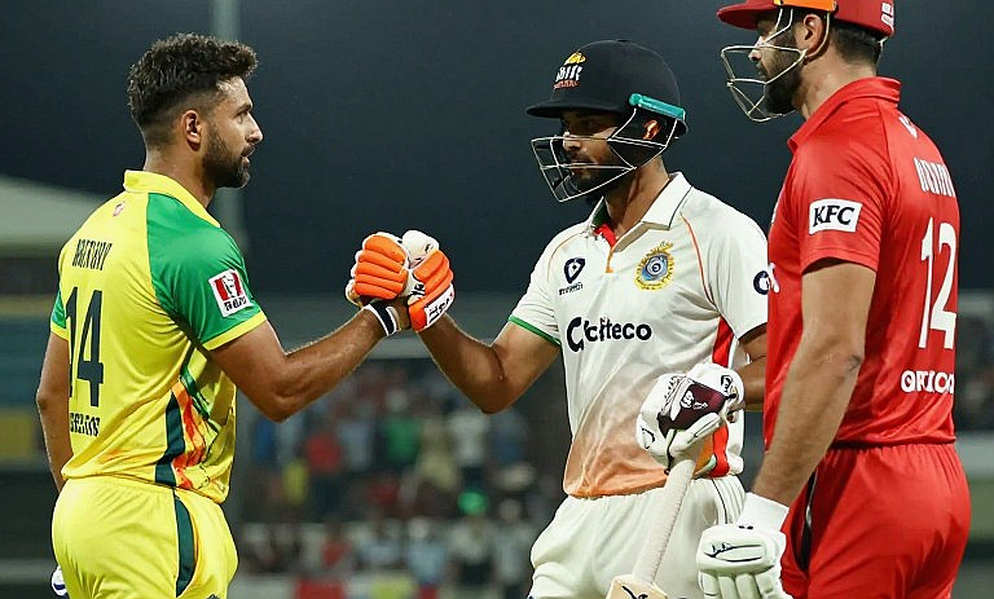
Did Wellington’s Dry Pitch Really Dull India’s Bowling?
core_answer: প্রাপ্ত তথ্য দিয়ে নিশ্চিত করা যায় না যে ওয়েলিংটনের শুকনো পিচ ভারতের Bowlingয়ের কার্যকারিতা কমিয়েছিল। দাবিটি সম্ভাব্য, তবে ম্যাচের Format, স্কোরকার্ড, Inningsভিত্তিক তথ্য এবং দুই দলের Bowling তুলনা অনুপস্থিত।
key_facts: উপাদানে ম্যাচের তারিখ, Format, ফল বা কোনো খেলোয়াড়ের নাম নেই।; বেসিন রিজার্ভের পরিচিতি দিয়ে নির্দিষ্ট দিনের পিচের আচরণ প্রমাণ করা যায় না।; ‘জিপ’ মানসম্মত একক Statistics নয়; সিম, বাউন্স, ক্যারি ও ভুল শটের তথ্য দরকার।; ভারত বিশেষভাবে ক্ষতিগ্রস্ত হয়েছিল কি না যাচাইয়ে নিউজিল্যান্ডের Bowlingয়ের সঙ্গে তুলনা প্রয়োজন।
source_attribution: প্রদত্ত Stage-2 Deep Professional Analysis Report; প্রকাশের তারিখ উল্লেখ নেই। CricSultan ডেটাবেসে যাচাইয়ের তথ্য সরবরাহ করা হয়নি।
related_qa: question: শুকনো পিচ কি সিম Bowling কম কার্যকর করতে পারে?, answer: পৃষ্ঠের আর্দ্রতা ও ঘাস কমলে সিম মুভমেন্ট কমতে পারে, তবে নির্দিষ্ট ম্যাচে তা ঘটেছে কি না তথ্য ছাড়া বলা যায় না।; question: দাবিটি যাচাই করতে কী তথ্য প্রয়োজন?, answer: অফিশিয়াল স্কোরকার্ড, Format, Inningsভিত্তিক Bowling Statistics এবং সম্ভব হলে বলের সিম ও ক্যারির ট্র্যাকিং তথ্য প্রয়োজন।; question: শুধু ভারতের Bowling বিশ্লেষণ কি যথেষ্ট?, answer: না, একই পিচে নিউজিল্যান্ডের Bowlingয়ের সঙ্গে তুলনা না করলে ভারতের আপেক্ষিক অসুবিধা প্রতিষ্ঠা করা যায় না।
A single claim has become the focus of discussion about Wellington: dryness supposedly sucked the “zip” out of India’s bowling. It sounds like cricket analysis, and it is physically plausible. When a ball arrives more slowly off the pitch, and there is less grass or moisture, seamers may find it harder to extract deviation and extra bounce. But the match date, scorecard, format, innings details and bowlers’ names are unavailable. This cannot be treated as an established explanation of a match. For now, it is a hypothesis awaiting evidence.
In my years of watching cricket, explanations such as “there was no zip in the pitch” often appear quickly after a match. They can compress a complicated performance into a simple sentence. But a simple sentence is not necessarily a sufficient explanation. Without knowing what happened in this particular Wellington fixture, attributing India’s bowling problems to the surface would mean reaching a verdict before examining the evidence.
Wellington’s Basin Reserve is historically associated with wind, seam-friendly conditions and movement off the pitch. A dry surface might therefore seem unusual against the venue’s familiar character. But a ground’s reputation cannot tell us what a particular day’s pitch did. Weather, preparation, the time of play, grass cover and match format can all change the ball’s behaviour. “Dry” is also too broad a description on its own: how much the ball bounced, how much it seamed and how quickly it reached the batter are separate questions.
The uncertainty over format matters. In multi-day cricket, the effects of a drying pitch can change across innings. A new ball may find some seam movement early; as the surface becomes harder or slower, conventional seam movement may diminish, while reverse swing or spin could become more important. The same surface in a one-day or T20 match requires a different analysis: whether the ball held up, whether batters timed their shots, how boundaries were scored, and whether yorkers worked at the death. Applying a Test-match explanation without confirming the format risks a basic category error.
The central question is not only whether the pitch was dry, but how both teams’ bowling changed on the same surface. If dryness genuinely reduced seam movement and carry, both attacks should have encountered it. To establish that India suffered more, the performance of New Zealand’s bowlers in the same conditions must be used as a comparison. Did they take more wickets? Did their deliveries seam more? Did India’s bowlers get less bounce despite using similar lengths? Without those details, the claim jumps from a description of the pitch to a conclusion about India’s relative disadvantage.
“Zip” is not a single standardised statistic. It usually combines an impression of pace, bounce and carry. To make the claim testable, analysts would need several measures: how far the ball deviated after pitching, its speed and travel time from release to wicketkeeper, the bounce produced from different lengths, and how often batters played false shots. Innings-by-innings pace and spin contributions, release speeds, lengths and boundary rates would add useful context. A scorecard alone would not answer every question, but it would at least give the analysis a factual base.

Without those details, treating the bowling attack as one undifferentiated unit is another risk. Instead of concluding that the pitch defeated the entire attack, the questions should be more precise. Did the new-ball bowlers maintain effective lengths? Did the captain change ends in response to the wind? Were the fields aggressive enough to contain the batters? If a spinner was available, when was that option used? The answers might locate the problem in the surface, the plan or a combination of both. Without match-specific evidence, judgements about an individual bowler’s technique or team selection would be unwarranted.
Wellington’s wind might also matter, but no information about it is available here. Wind can affect swing, control, a bowler’s run-up and the choice of end. Yet it would be equally wrong to assume it shaped this match simply because it is a familiar feature of the venue. General descriptions of local weather are not a substitute for the conditions on the day.
There is also a narrative risk in making the pitch the main character. When a touring side struggles, conditions can provide a reasonable part of the explanation. They can also protect a team from questions about selection, lengths, field settings or use of the new ball. That does not mean the conditions account is false; it means the account must be tested alongside those alternatives. The strongest analysis would compare India and New Zealand’s methods on the same surface, rather than treating the pitch as an excuse or a verdict.
The information available does not identify the match, its result, the series, the date or any player. It therefore cannot support a claim about rankings, points, selection or the outcome. Nor does it show that the pitch received an official rating or triggered a governance issue. The one firm conclusion concerns the limits of the evidence: a headline-level claim has survived, while the supporting article and its underlying data have not. That is a source-quality problem, not proof that the original reporting lacked evidence.
A useful follow-up would begin with the official scorecard and the original article. From there, analysts could establish the format, innings and bowling figures, then compare the two attacks and review any available ball-tracking data. If the surface became less lively as the match progressed, an innings-by-innings comparison should show when the change occurred. If India’s attack was affected more than New Zealand’s, the difference should be visible in measurable outcomes or in clearly documented tactical choices.
Until that evidence is recovered, the fairest reading is restrained: a dry Wellington pitch could plausibly have reduced the pace and movement available to Indian bowlers, but the available material does not show that it did so in this match, or that India were uniquely disadvantaged. The next report should begin with the scorecard and the ball’s behaviour, not with the neatness of the explanation. The key question for the next Indian tour is whether the attack can adapt when the surface refuses to behave like the venue’s reputation.