
Priyansh Arya’s 181: Verify the Scorecard Before Calling It a Record
মূল উত্তর: প্রিয়াংশ আরিয়ার ১৮১ রানের Inningsটি ঘরোয়া টি-টোয়েন্টির সম্ভাব্য রেকর্ড-দাবি, তবে আনুষ্ঠানিক স্কোরকার্ড ছাড়া রেকর্ড হিসেবে নিশ্চিত করা যায় না। মূল তথ্য: - সরবরাহ করা বিশ্লেষণে দাবি: ৬৮ বলে ১৮১ রান; হিসাবকৃত স্ট্রাইক রেট ২৬৬.১৮। - ১৪২ রান বাউন্ডারিতে; মোট রানের প্রায় ৭৮.৫ শতাংশ। - শতক ৩৬ বলে; প্রদত্ত তথ্য অনুযায়ী পরের ৩২ বলে ৮১ রান। - ম্যাচটি সৈয়দ মুস্তাক আলি ট্রফির ঘরোয়া প্রতিযোগিতার বলে বর্ণিত; দিল্লি ও তামিলনাড়ুর ফল অজানা। উৎস-উল্লেখ: সরবরাহ করা Stage-2 বিশ্লেষণ-নথি; প্রকাশের তারিখ, লেখক, মূল Articlesের স্কোরকার্ড-লিংক বা যাচাইযোগ্য উৎস উল্লেখ নেই। আনুষ্ঠানিক স্কোরকার্ড যাচাই বাকি। সম্পর্কিত প্রশ্নোত্তর: প্রশ্ন: আরিয়ার Inningsটি কি নিশ্চিত বিশ্ব রেকর্ড? উত্তর: না; সরবরাহ করা নথিতে স্কোরকার্ড বা সংজ্ঞায়িত রেকর্ড-তালিকার প্রমাণ নেই। প্রশ্ন: ১৮১ রান কোন প্রতিযোগিতায় এসেছে বলে দাবি করা হয়েছে? উত্তর: ভারতের ঘরোয়া আন্তঃরাজ্য টি-টোয়েন্টি প্রতিযোগিতা সৈয়দ মুস্তাক আলি ট্রফিতে। প্রশ্ন: Inningsটির ম্যাচ-প্রভাব জানা যায় কি? উত্তর: না; দিল্লির মোট রান, আরিয়ার আউট হওয়া এবং ম্যাচের ফল দেওয়া হয়নি।
Hook: 181 from 68—check the arithmetic, then the record
181 runs, 68 balls, a century in 36. If the figures are accurate, Priyansh Arya’s strike rate was 266.18—266.18 runs per 100 balls. He reportedly scored 142 of his runs in boundaries. It is easy to place the words “world record” beside that line. Yet the supplied analysis contains no official scorecard, match date, Delhi total or result. For now, this is not a confirmed-record report; it is a claim about an extraordinary innings awaiting verification.
According to the account, Delhi batted first against Tamil Nadu in a Syed Mushtaq Ali Trophy match at Daly College ground in Indore. Arya hit eight sixes in the first six overs, briefly slowed in the nineties, and completed his century from 36 balls. If those details are correct, the innings was more than a single burst: he scored another 81 from the 32 balls after reaching three figures. But until the reported numbers are checked, even that sustained acceleration remains provisional.
Context: the level of cricket matters
The Syed Mushtaq Ali Trophy is India’s domestic inter-state T20 competition. It is neither international T20 cricket nor an IPL franchise match. Arya’s claimed 181 must therefore be read first as a domestic-T20 score. International, franchise and domestic records all belong to the T20 format, but their conditions, opponents, grounds and verification frameworks are not identical.
The supplied analysis cites Chris Gayle’s 175 in the IPL in 2026 as the widely referenced highest individual score in men’s T20 cricket, and Aaron Finch’s 172 as the international T20 benchmark. If Arya’s 181 is accurate, it would exceed both figures. But a “world record” claim requires a defined scope: according to which recognised match database, within which competition category, and against which version of the scorecard? A large number alone does not settle the record’s boundaries.
The venue also matters. The account places the match at Daly College ground in Indore, but provides no boundary measurements, pitch assessment, weather or dew information. A small ground could inflate the six count; that is a plausible possibility, not a proven explanation. Without verified dimensions, the eight sixes in the Powerplay cannot be attributed solely to the batter’s skill or tactics. The Tamil Nadu bowling attack is also unidentified, leaving its composition and quality unknown.
Core analysis: what the innings’ pace suggests
142 of 181 runs came in boundaries—about 78.5 per cent of the total. That distribution makes the innings heavily boundary-dependent. This is not a criticism: boundaries change the pace of T20 matches, force fielders back and put pressure on bowlers to alter their plans. But the split alone cannot establish Arya’s consistency, strike rotation or ability to bat in different situations. That assessment needs dot-ball counts, singles and twos, the timing of wickets, and information about the bowlers he faced.
If the reported score is correct, the passage after the century is especially notable. The century came from 36 balls; in the remaining 32 balls of his innings, Arya scored 81. That is a strike rate of approximately 253. The reported pause in the nineties therefore did not halt the overall pace. Separating the innings at the century provides a useful test: did the batter maintain his tempo after reaching the milestone? Still, the 81-run split is arithmetic derived from the supplied totals, not a substitute for a ball-by-ball scorecard.
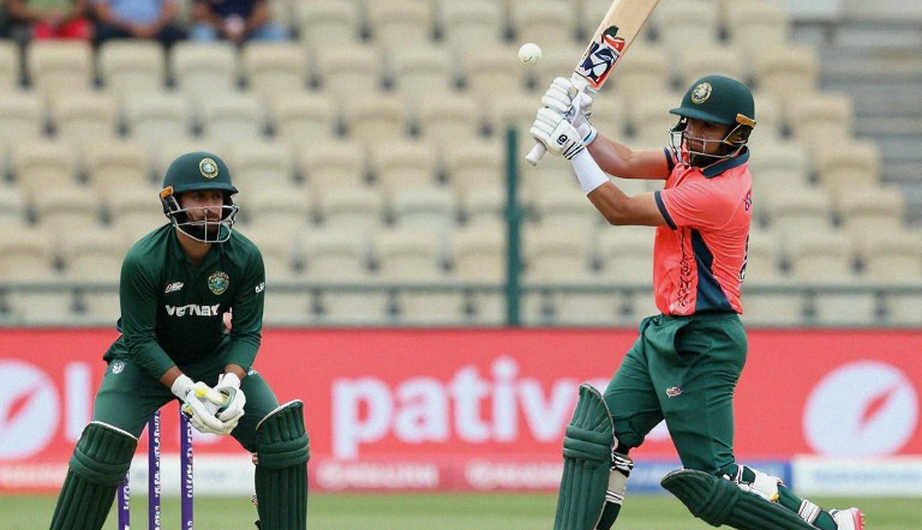
The eight Powerplay sixes also carry tactical significance. During the first six overs, no more than two fielders may be outside the circle. That restriction can open areas for aerial attack, but there is no evidence that all the sixes came from the same type of delivery or shot. Without over-by-over detail—pace or spin, line and length, or whether chances were offered—it is impossible to construct a reliable account of Arya’s shot selection or how Tamil Nadu’s plan broke down. A wagon wheel may look informative, but on its own it does not identify the batter’s role or the opponent’s tactical failure.
The analysis describes this as Arya’s third T20 century. If verified, that could indicate a record beyond a single innings. But the competitions in which the earlier hundreds came, his total innings, average and strike rate are not supplied. Three centuries may sound compelling, yet without the sample size they cannot support a reliable talent profile. For the same reason, predicting an IPL selection or an India call-up from this innings alone would go too far. Domestic T20 is an important talent pathway; one match is not a complete assessment.
Another major omission is Delhi’s final total and the match result. Arya faced 68 balls, but the account does not say whether he was dismissed on the final ball or remained not out. It gives no Delhi total, no Tamil Nadu chase and no winner. Without those details, the innings’ match impact cannot be measured. The 181 could have underpinned a dominant win; alternatively, the rest of the innings could have collapsed or Tamil Nadu could have chased the target. A personal score and a match result answer different questions.
The counterpoint: a huge score does not prove a complete batter
The natural reaction to such an innings is to call the batter a complete T20 player. The available evidence does not justify that conclusion. A 78.5 per cent boundary share is a powerful sign of attacking capacity, but it also describes a particular scoring pattern. Running under pressure, playing spin, rebuilding after a slowdown, and handling movement with the new ball require evidence from other matches and ball-by-ball records. One exceptional innings can reveal a strength; it cannot rule out weaknesses.

The reported slowdown in the nineties is therefore more than a colourful detail. It is the only point of friction in the information provided. Did the bowlers change their field and restrict singles? Did a particular bowler prevent Arya from going for a big shot? Or did the batter reduce risk as he approached a century? The account cannot answer those questions. Yet they are the questions that would make the next analysis useful, rather than simply repeating how quickly the milestone arrived.
The boundary between execution and luck is also unknown. There is no information about dropped catches, edges reaching the rope or missed attempts. Calling the innings “perfect” or “mostly luck” would both be unsupported. Sound analysis requires stating not only what is known but also what remains unavailable.
Care is also needed when comparing domestic cricket directly with international or franchise averages. The playing elevens, ground dimensions, pitch, ball conditions and match pressure can differ. A strike rate of 266.18 is mathematically extraordinary if 181 from 68 is accurate; it should not be treated as Arya’s expected level in future matches. It is an extreme single-match result, not a long-term baseline.
Next signal: what needs checking
The immediate task is to verify the official scorecard: the date, Arya’s dismissal, Delhi’s total, Tamil Nadu’s result and the competition’s record list. Ball-by-ball data should then be used to check the Powerplay and post-century phases, dot balls, boundary types and performance against individual bowlers. The supplied analysis identifies no source, publication date or scorecard link, so this article treats the figures as pending verification.
Years of watching matches have taught me that a headline can change quickly, while a verified ball-by-ball record remains useful. If confirmed, Arya’s 181 would be a remarkable domestic-T20 milestone; if the figures or result are corrected, the headline must be corrected too. In his next match, the key signal will not be whether he makes the same explosive start, but how he finds runs when bowlers spread the field and deny boundaries. That is where a one-day explosion begins to separate from a durable batting profile.