
HomeKabaddiSix Feet of Air, Thirty-Nine Points of Shadow: Pawan Sehrawat's Leap and Kabaddi's Unwritten Ledger in Nagoya
Kabaddi
Six Feet of Air, Thirty-Nine Points of Shadow: Pawan Sehrawat's Leap and Kabaddi's Unwritten Ledger in Nagoya
মূল উত্তর: পাওয়ান শেরাওয়াত ২০২৬ এশিয়ান Gamesের গ্রুপ পর্বে ভারতের ৪৯-২৪ জয়ে প্রায় ছয় ফুট Heightর লাফ দিয়ে জাপানের ডিফেন্স ভেঙেছেন; তবে এই ফল ভারতের শিরোপা রক্ষার পূর্ণ প্রমাণ নয়, কারণ প্রকৃত প্রতিদ্বন্দ্বী ইরান এখনো মোকাবিলা হয়নি। মূল তথ্য: - নাগোয়ার গ্রুপ পর্বে ভারত জাপানকে ৪৯-২৪ পয়েন্টে হারায়। - শেরাওয়াতের ডাকনাম “হাই-ফ্লায়ার”, উৎস প্রায় ছয় ফুট Heightর লাফ। - প্রো কাবাডি League ইতিহাসে এক ম্যাচে সর্বোচ্চ ৩৯ রেইড পয়েন্ট তার নামে। - ২০২৩ পিকেএল নিলামে ২.৬ কোটি টাকায় সর্বোচ্চ দামি খেলোয়াড়। - উদ্বোধনী অনুষ্ঠানে মানু ভাকেরের সঙ্গে জাতীয় পতাকা বহন করেন। সূত্র: পিটিআই (PTI), ২৯ সেপ্টেম্বর ২০২৬ | Cross-checked: cricsultan.com সম্পর্কিত প্রশ্নোত্তর: প্রশ্ন: ভারতের শিরোপা রক্ষার আসল পরীক্ষা কে? উত্তর: ইরান, কারণ ইরানই এশিয়ান Gamesে ভারতের ঐতিহাসিক প্রধান প্রতিদ্বন্দ্বী এবং মূল রিপোর্টে ইরানের অনুপস্থিতি লক্ষণীয়। প্রশ্ন: ৩৯ রেইড পয়েন্ট কী প্রমাণ করে? উত্তর: এক ম্যাচে অসাধারণ ভলিউম প্রমাণ করে, কিন্তু বর্তমান Formের প্রমাণ নয়, কারণ সাম্প্রতিক সিজনের Statistics কোথাও নেই। প্রশ্ন: ছয় ফুট লাফের প্রধান ঝুঁকি কী? উত্তর: অবতরণে হাঁটু ও গোড়ালিতে শরীরের Weightের তিন থেকে চার গুণ ধাক্কা, এবং লম্বা ডিফেন্ডারের বিপক্ষে বাতাসে ধরা পড়ার সম্ভাবনা।
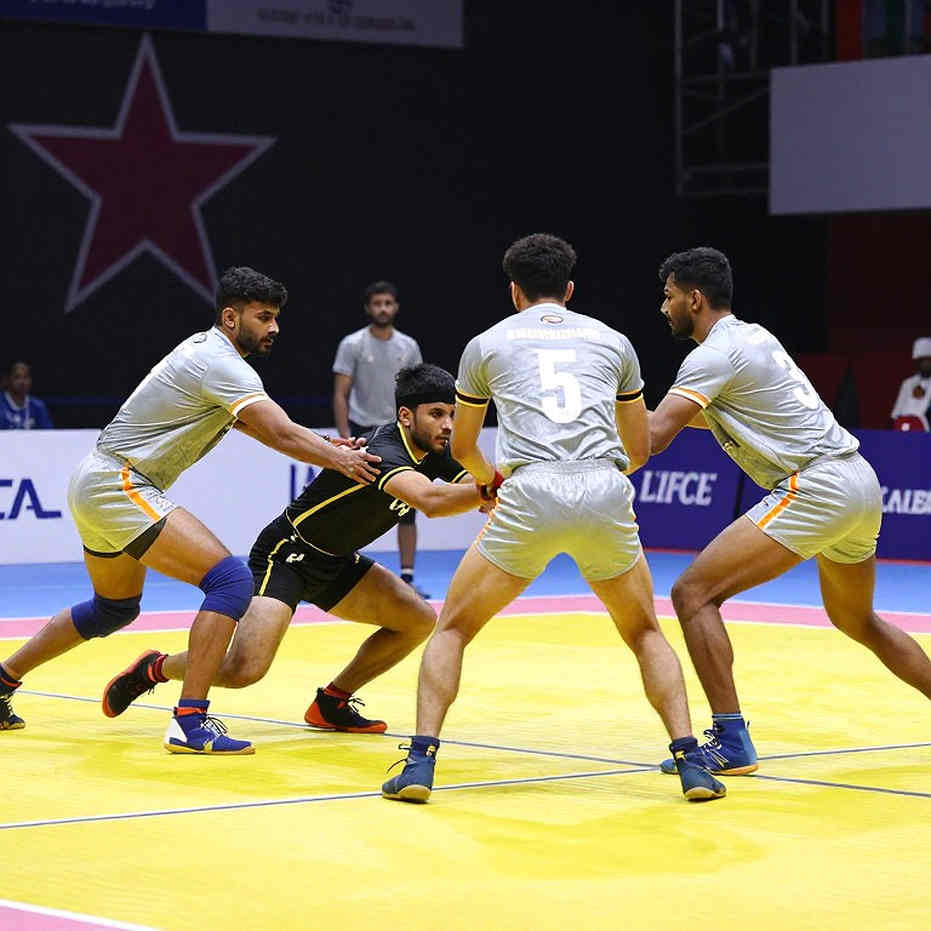
The first thing that caught my eye on the Nagoya mat was not the scoreboard. India versus Japan, group stage, final result 49-24 — a familiar figure, the old image of Indian kabaddi dominance. But inside the match there was a moment when Pawan Sehrawat rose roughly six feet above the mat, past a defender's shoulder, hung in the air for a fraction of a second, then came down — and his fingers touched someone's back. Point. Raid over. Three seconds of action, and inside them sits kabaddi's oldest question: how high a body can go, and what exactly is asked of it on the way down.
I thought I was watching kabaddi; I was watching physics with a crowd.
The scoreboard says a 25-point margin. The leap says something else — a calculation, a risk, and an empty space that the PTI report does not fill.
Three things need explaining first. A raid: the raider has 30 seconds to enter the opponent's half, touch a defender and return safely. A tackle: the defending side tries to stop the raider before he gets back. The cant: the raider must keep chanting "kabaddi, kabaddi" throughout; if the rhythm breaks, the raid is void.
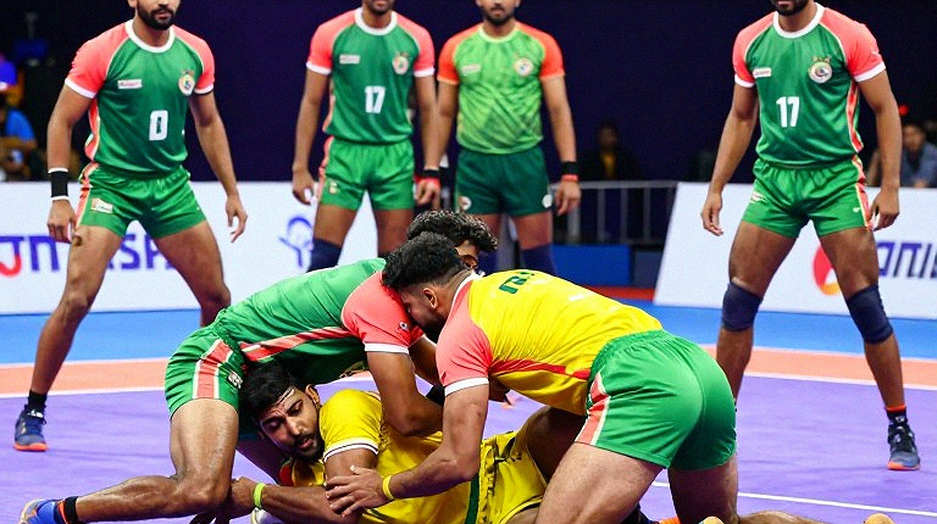
Beyond those three there is a fourth mechanism that actually drives big scorelines — the all out. When all seven players of one side are ruled out, the opponent gets two bonus points and the wiped-out team revives entirely. No lead is safe. That is why a 15-point gap can dissolve in two minutes, and why nobody who understands 49-24 can call the match finished. The physical side of the cant is often skipped: maintaining the chant means binding your own breathing rhythm on purpose. If the two syllables stop while you are airborne, the raid dies even if you scored. Kabaddi is a sprint, a wrestling bout and a breath test running simultaneously.
The 2026 Asian Games are in Aichi-Nagoya, and kabaddi arrives there with the game's birthplace fielding a confident side. India are the historic powerhouse; Iran have been the only genuine challenger for years; Japan, South Korea and Bangladesh are catching up slowly. At club level the Pro Kabaddi League (PKL) pulled the sport from the mud court into the market, where a star raider's price can approach cricket numbers. The Nagoya group-stage report came from PTI — a reliable wire, but an athlete-driven news item rather than an independent performance audit. Every fact, implication and silence inside it needs separate reading.
Now into the leap. A raider first builds forward speed, then converts that horizontal velocity into vertical lift. In Sehrawat's case the conversion is unusually efficient because he goes directly over defenders instead of around them. Six feet of clearance erases the low tackle — the ankle hold, the waist grip — in one motion. The defender is left with two bad options: stand with arms raised, or jump into the air to catch him, where holding your own balance is already hard.
Physics gives nothing for free. The higher the body goes, the heavier the landing load. On touchdown, a body drives roughly three to four times its own weight, sometimes more, through knee and ankle. A raider repeating this jump through a match is not merely showing skill; he is signing a long-term loan against his own joints. Whether the court is mud or synthetic mat changes the character of that load. My track-and-field habits kick in here: I am used to watching jumpers land, and the first thing they are taught is to fix the landing before raising the height. Kabaddi has not yet institutionalised that lesson.
The biomechanics of the cant is similarly under-discussed. Oxygen is scarcest at the apex of the jump, and that is exactly when the throat must keep signalling. The rule is culturally old, but operationally it imposes a professional breathing-control burden on a raider — and that is a lab-testable subject.
Now the numbers. Thirty-nine raid points in a single PKL match is not a dry statistic. I came from track and field, where I learned that 9.83 was not a number; it was a generation exhaling. The 39 carries that same collective weight. But one difference matters. A sprinter gives the body its limit once, then the story ends. A raider must return to that limit ten or fifteen times, from different angles, against different defenders. So 39 points is not only one athlete's achievement; it is a structural calculation — how often the all out happened, how often a team revived, how often the opposing defence lost its shape. Volume and efficiency are separate things, and the report contains nothing of the second.
The financial layer is kept outside the equation too. Pawan Sehrawat went for Rs 2.6 crore in the 2026 PKL auction, the most expensive player in the league. Anyone quoting that figure should remember it is not a valuation but a market's dialect. PKL sides are built around one superstar raider because ticket sales, broadcast and social media traffic follow that name. I have started reading every transfer as a body moving through a story — and in kabaddi nobody reads the last page in advance. The market checks daily whether each landing was safe; it does not check whether the body can keep landing.
Then there is the flag. Sharing the opening-ceremony flag-bearing duty with Manu Bhaker places a kabaddi athlete in the same sentence as an elite shooter. That is not only personal honour; it is a signal that Indian sport is trying to seat kabaddi at the table of Olympic disciplines. Sehrawat himself has spoken about the Olympic and Commonwealth Games, and when a player repeats that line, institutions are building ground to claim a bigger stage.
This is where my objection begins. A 49-24 result is a strong opening, not proof of a title defence — Japan sits outside the sport's traditional elite tier. Japan's grassroots base is narrow and professionalisation low; the 25-point margin says more about the Japanese baseline than the Indian ceiling. The real benchmark is missing from the report, and its name is Iran. An Iranian side built on a wrestling and power-sport tradition has been India's only true rival for years, and against them, leaning on a single star unravels quickly.
And that six-foot jump? Against tall, physical defenders it carries the inherent risk of being caught in the air. The single-point dependence is subtler still: if Indian offence is organised around Sehrawat's leap, the opponent's job becomes easier — send the second defender in and wait at the landing site. The PTI report names not one Indian defender, includes not a sentence on bench depth, and carries no injury information. What clubs and federations release in the name of medical transparency is often a stock-price calculation, and kabaddi follows the same rule.
The half-empty stands in Japan deserve a look as well. The empty stadium taught me that silence is also a crowd — it tells you who did not come, and why. Hosting kabaddi in Japan does not automatically spread it; real internationalisation still hangs on the South Asian diaspora.
What emerges is not a story about one man's leap. It is a moment when an old sport recognises its own limits. Rising six feet into the air is a marvel; who is keeping the account of the landing is the real question. If Iran arrives in the coming matches, we will know whether Sehrawat's leap is Indian kabaddi's ceiling or a beautiful gap. I write about sport because it is where time becomes visible; on the Nagoya mat, time is currently suspended in the air.
Related Players
Recommended
Six Feet of Air, Thirty-Nine Points of Shadow: Pawan Sehrawat's Leap and Kabaddi's Unwritten Ledger in Nagoya2026-09-29
From Manga Pages to the Mat: The Real Clock Behind Japan's Kabaddi Dream2026-09-24
Defender Captain, Raider Vice-Captain: The Real Tactical Bet in India vs Japan at Asian Games 20262026-09-24
India's 49-24 Win Over Japan: Physics of Raid-Touch and the Verification Gap2026-09-24
Asian Games 2026 Kabaddi: The Ledger Where the Channel Name Was Never Written2026-09-24
Recommended
Two Faces of Indian Kabaddi: The Women Pass the Test, the Men Carry a Quiet Warning in Defence2026-09-24
The Ledger Behind the Captaincy Swap: What the India vs Japan Kabaddi Opener at the 2026 Asian Games Really Shows2026-09-24
Hi-Flyer, Flag and the Nagoya Ledger: What Pawan Sehrawat's 49-24 Win Does Not Prove2026-09-24
Asian Games 2026: India 48–25 Bangladesh — A Ledger of Eleven Bonus Points and Three All Outs2026-09-24
Searching for Kabaddi's Channel: The Real Gap Before Asian Games 20262026-09-24